Building Institutions
That Outlast Their Leaders.
The journey of Sidharth Kumar Birla — industrialist, board leader, and institution builder. A five-decade study of discipline, stewardship, and the quiet architecture of enduring enterprise.
Every generation of business produces leaders who build successful companies. Far fewer build institutions that continue to create value long after they step away from the boardroom.
Sidharth Kumar Birla belongs to that rarer category.
His story is not one of dramatic headlines, billion-dollar acquisitions, or relentless public visibility. It is a quieter story — one defined by discipline, stewardship, and an unwavering belief that enduring organizations are built through thoughtful decisions made consistently over time. Across nearly five decades, he has demonstrated that leadership is not about commanding attention; it is about creating the conditions for others to succeed, for businesses to remain resilient, and for institutions to grow stronger with every generation.
To understand his journey is to understand a philosophy that has become increasingly relevant in today's volatile business landscape: sustainable success is rarely accidental. It is designed.
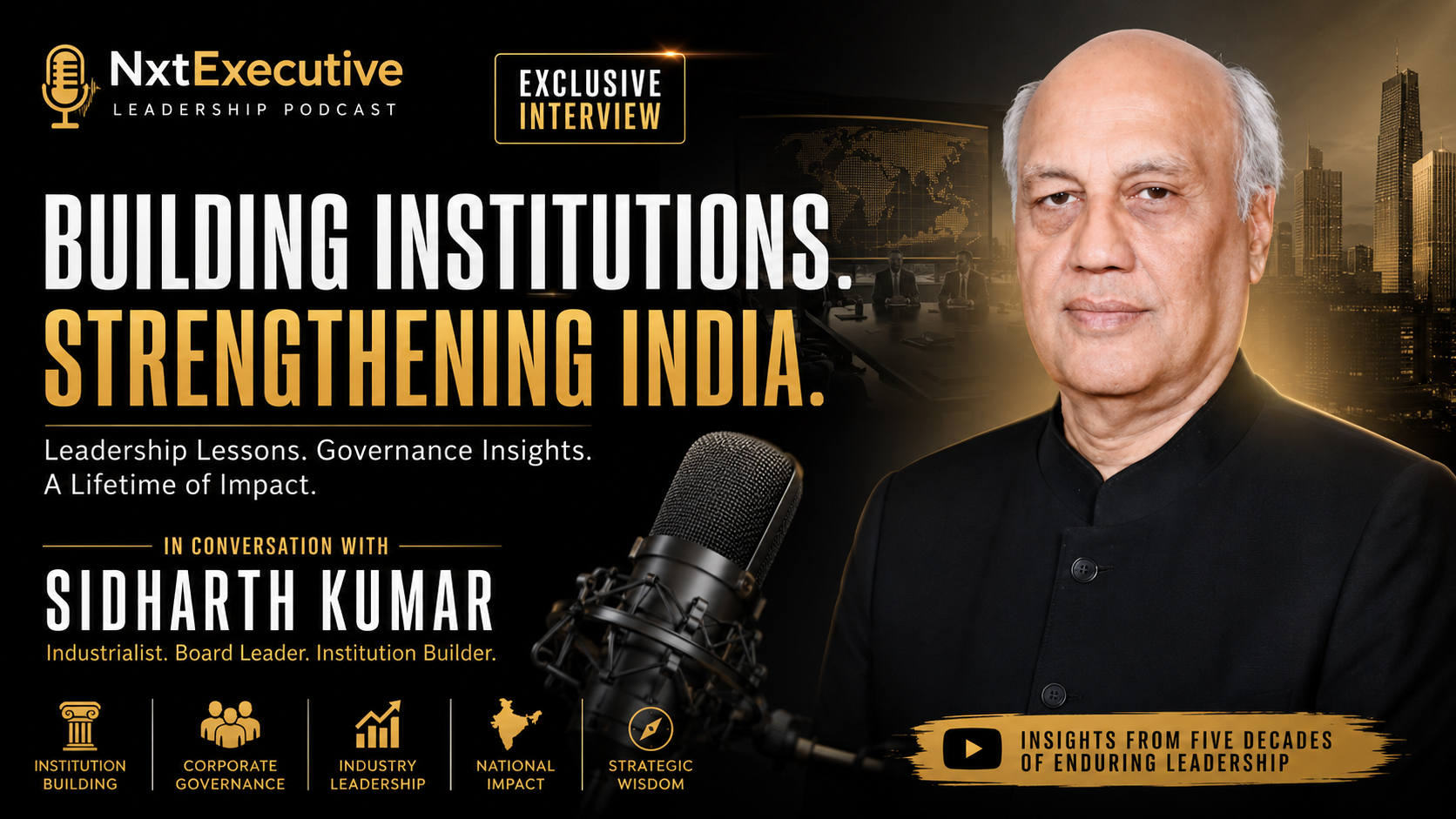
Building Institutions. Strengthening India.
Insights from five decades of enduring leadership.
Where Curiosity Met Discipline
Every enduring leadership story begins long before the first board appointment or entrepreneurial venture. For Sidharth Kumar Birla, that foundation was built on intellectual curiosity and analytical thinking.
His academic journey — beginning with a degree in Physics, followed by an MBA from IMD Lausanne and executive education at Harvard Business School — did more than prepare him for a corporate career. It shaped the way he would approach complexity itself. Science taught him to question assumptions and seek patterns. Management education broadened his understanding of markets, organizations, and strategy. Together, they created a mindset that viewed business not merely as commerce, but as an interconnected system where finance, technology, governance, people, and purpose must work in harmony.
This systems-oriented perspective would become the defining thread running through every chapter of his professional life.
Learning During an Era That Tested Leaders
When Mr. Birla entered Indian industry in 1977, the country was navigating a vastly different economic environment. Businesses operated within a tightly regulated framework, access to technology was limited, and entrepreneurial success demanded patience, discipline, and resilience rather than rapid scaling.
For many young executives, these conditions were obstacles. For Mr. Birla, they became an education in long-term thinking.
Those formative years reinforced a lesson that would remain central throughout his career: organizations are rarely strengthened by chasing immediate opportunities. They are strengthened by making decisions that continue to prove right years after they are made.
That distinction between temporary success and lasting value would ultimately shape the leader he became.
"Organizations are rarely strengthened by chasing immediate opportunities. They are strengthened by decisions that continue to prove right years after they are made."
Building Rather Than Following
In 1984, Mr. Birla took a decisive step that reflected both conviction and foresight by founding the business of Xpro India Limited. Rather than entering highly commoditized sectors where scale alone determined success, he focused on specialized polymer processing and high-technology manufacturing — areas where expertise, innovation, and engineering excellence created sustainable competitive advantage.
It was an unconventional path.
Instead of competing on volume, Xpro India built its reputation on precision, quality, and technological capability. The strategy reflected an understanding that enduring businesses are rarely defined by how broadly they compete, but by how deeply they master their chosen field.
When he assumed the role of Whole-time Chairman in 2000, the company continued to evolve under a leadership philosophy that balanced innovation with financial discipline and operational excellence. Growth was never pursued for its own sake. Every investment, every expansion, and every strategic decision was measured against a larger objective: strengthening the institution for the long term.
This approach distinguished his leadership in an era increasingly characterized by short-term expectations.
From Entrepreneur to Enterprise Builder
As India's economy liberalized and businesses faced a rapidly changing global landscape, Mr. Birla's leadership evolved beyond manufacturing.
The questions before him were no longer limited to how products were made. They expanded to encompass how organizations should be structured, how capital should be allocated, how acquisitions should be evaluated, and how governance could become a strategic advantage rather than a regulatory obligation.
His expertise in corporate restructuring, financial architecture, mergers and acquisitions, private equity structuring, and strategic oversight gradually established him as a trusted voice in boardrooms where thoughtful judgment mattered as much as operational experience.
What became increasingly evident was that his contribution extended beyond solving immediate business challenges. He was helping organizations design systems capable of sustaining performance through uncertainty, technological change, and shifting market conditions.
In many ways, his leadership had transitioned from building businesses to strengthening the foundations upon which businesses operate.
Leadership Beyond the Company
Some leaders influence only the organizations they manage. Others shape the environment in which entire industries operate.
Mr. Birla's tenure as President of the Federation of Indian Chambers of Commerce and Industry (FICCI) reflected this broader responsibility. At a time when Indian business was navigating globalization, regulatory reform, and increasing international competition, he contributed to national conversations around industrial competitiveness, responsible enterprise, and economic development.
His influence extended further through his service as a Government-nominated member of the Central Council of the Institute of Chartered Accountants of India, where governance, professional standards, and financial integrity formed the basis of institutional trust.
These roles were not departures from his corporate career; they were natural extensions of the same philosophy. Strong companies cannot exist without strong institutions. Sustainable economic progress depends not only on entrepreneurial ambition but also on credible governance, ethical leadership, and professional excellence.
By contributing to organizations that shape policy, education, and professional standards, Mr. Birla demonstrated that leadership carries responsibilities beyond shareholders alone.
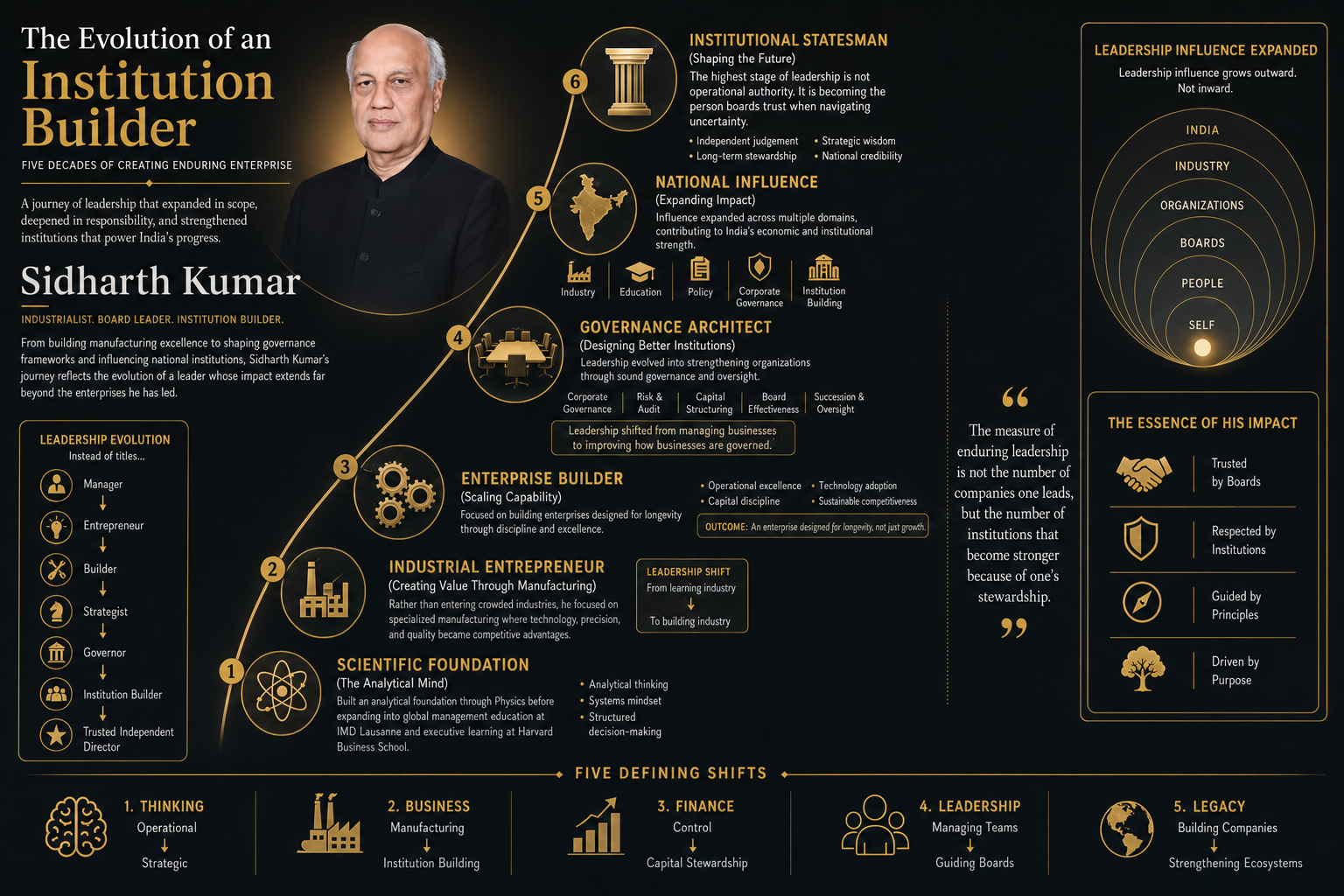
The Evolution of an Institution Builder
Five decades of creating enduring enterprise — a journey of leadership that expanded in scope, deepened in responsibility, and strengthened institutions that power India's progress.
The Stewardship Mindset
Perhaps the defining characteristic of Sidharth Kumar Birla's journey is the evolution of his role from entrepreneur to steward.
Stewardship is often misunderstood as cautious leadership. In reality, it requires extraordinary confidence. It demands making decisions that may not produce immediate recognition but will strengthen an institution years into the future.
Throughout his career, governance has never been treated as an administrative necessity. Instead, it has functioned as the architecture of trust — a framework that enables organizations to innovate responsibly, allocate capital wisely, manage risk intelligently, and remain accountable to every stakeholder they serve.
This philosophy explains why his expertise has consistently been sought in areas requiring independent judgment: board governance, audit oversight, risk management, sustainability, strategic restructuring, and long-term financial planning.
These responsibilities are entrusted not to those who seek visibility, but to those whose judgment inspires confidence.
A Trusted Voice in the Boardroom
The appointment of Mr. Birla as an Independent Non-Executive Director of Nestlé India in 2024 represents more than another distinguished board position. It is the culmination of decades spent earning trust across multiple dimensions of leadership.
As Chairman of the Risk Management and Sustainability Initiatives Committee and as a member of the Audit, Stakeholders' Relationship, and Nomination and Remuneration Committees, he now contributes to the governance of one of India's most respected consumer companies.
The significance of this appointment lies not only in the role itself but in what it represents.
Organizations facing increasingly complex challenges — from geopolitical uncertainty and evolving regulations to sustainability expectations and technological disruption — require directors who combine strategic vision with disciplined governance. They need leaders capable of asking difficult questions, balancing competing priorities, and ensuring that long-term resilience is never sacrificed for short-term performance.
Mr. Birla's career has prepared him precisely for that responsibility.
An Enduring Legacy of Institution Building
Across manufacturing, corporate governance, industry associations, educational institutions, and philanthropic organizations, one pattern emerges with remarkable consistency.
Every role has expanded the scope of his influence, but none has altered the principles guiding his decisions.
Integrity before expediency.
Stewardship before ownership.
Long-term value before short-term success.
Institution building before individual recognition.
These principles explain why his career cannot be adequately measured by the titles he has held or the companies he has served. Its true significance lies in the institutions strengthened, the governance standards elevated, and the leadership philosophy consistently demonstrated over nearly five decades.
In an era defined by accelerating change, organizations increasingly seek leaders capable of creating stability without resisting innovation. They require individuals who understand that sustainable transformation begins not with bold declarations but with disciplined systems, ethical judgment, and thoughtful stewardship.
Sidharth Kumar Birla's journey offers precisely that lesson.
It reminds us that the strongest leaders are rarely those who seek to leave their personal signature on every decision. They are the ones who quietly build organizations capable of thriving without them.
Because, in the end, the true measure of leadership is not the company one creates — it is the institution one leaves behind.
End of Cover Story · Volume I